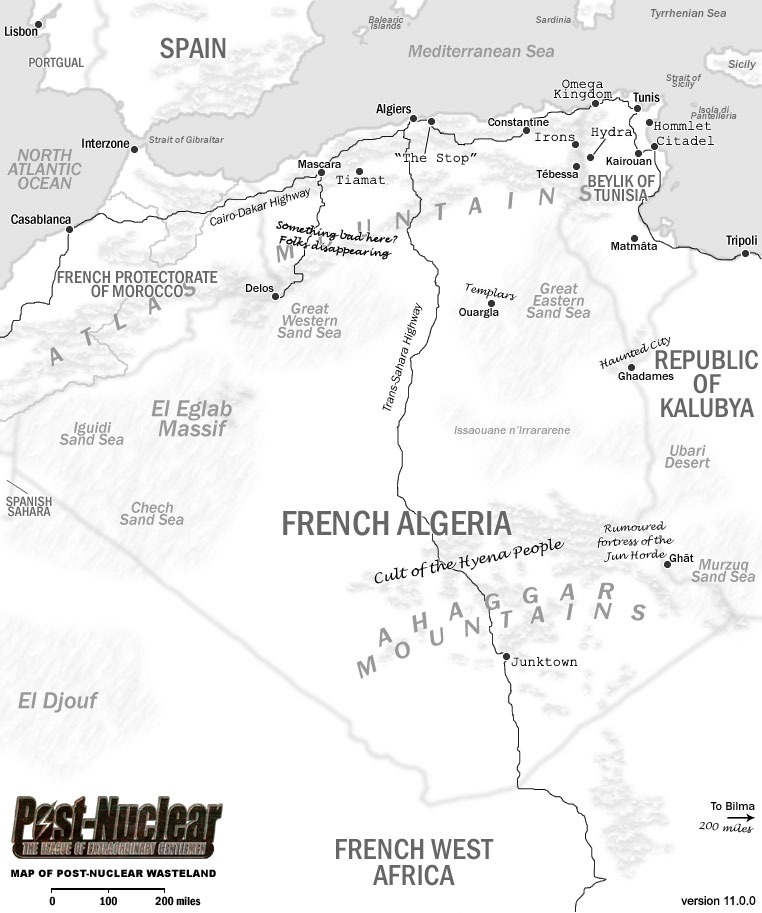
(Locations listed north to south.)
Algiers
Population: 185,000
The Mediterranean's largest port was attacked by "dirty bombs" in the war, so-called "weapons of mass disruption" designed to paralyse large urban population centres. With over 3 million people living in the metropolitan area, mostly Europeans used to a modern, urban lifestyle, Algiers had always teetered on a knife-edge. Entirely reliant on complex, high-tech systems for its survival; power stations, desalination plants, food imports, it only needed a shove to send the city plunging back into the dark ages.
The high radiation levels in Algiers may not have been immediately fatal but still caused lasting harm. Cancers and tumours would be rife in the survivors, and genetic mutation would corrupt the offspring of those that weren't made infertile. By far the greatest threat the survivors faced was each other.
The French Union had been decapitated. Paris had its own problems to deal with and its overseas territories were cut off. Concrete ruins cannot sustain life. The colonial government had abandoned Algeria, there was no orderly, stoic attempt to organise the survivors. It was every man for himself, and when groups did form, they were around racial and tribal divisions. There were finite resources in the city. Only so many shops to plunder, so many warehouses to raid. The descent into barbarism was inevitable.
⁂
Algiers is now a dusty, sprawling ruin, its streets choked with twisted rubble. The hundreds of thousands of survivors that didn't flee the city have been decimated by war, famine and plague. The gangs of savages that prowl Algiers are cut-throat, hostile to all outsiders. There's no trading with them, and travellers venturing into the city must either have overwhelming firepower or know how to avoid attention.
In recent times a fifth horseman has arrived in Algiers. Undeath. News and salvage from the city has become more scare and rumours speak of a deranged, ashen-faced vampire with no lips, spreading the curse and turning downtown Algiers into some kind of nightmarish carnival of death.
So it seems the city may be on the verge of a revival, but one even less welcome than its destruction...
"The Stop"
Population: 200
Ménerville was a small "Black-Foot" or colonial town before the war, located on a remote and sheltered mountain pass where the air was cool. It was otherwise notable only as a rail depot and truck stop on the Trans-African Highway.
Due to its isolation and over-reliance on through traffic, the town's already tiny population dwindled rapidly after the war. There were just a few hermits remaining when a Canuck soldier wandered into town one day. Taking a liking to the climate, the isolation, the rugged, steep hills, the soldier settled down and took over the local bar. Going by the name of "Patch", the soldier has been there ever since.
Over the decades more European refugees have bolstered the town, drawn by fertile soil and the "live and let live" attitude insisted on by Patch. If you can make yourself useful but otherwise mind your own business, you're welcome to stay. Otherwise, stop, rest a while, then be on your way. To travellers on the highway, the town has become known only as "the Stop" between Algiers and Tébessa. Its ramshackle, colonial-style buildings stand amidst a menagerie of makeshift lean-tos and greenhouses, and present an unimposing, hard working township.
Even to bandits and biker gangs, the Stop is an important waystation and not to be abused. The townsfolk produce fresh fruit and veg, biofuel and spirits and even meat. The steep slopes provide grazing for livestock and shepherds roam the northern escarpment of Djebel bou Arous, from where the Mediterranean can be seen.
For the town, convenience is their security. In the past a few rogues have tried to set themselves up as satraps but it doesn't usually take long for them to fall foul of Patch, and what he does to them isn't very nice.
Notes:
"Patch" is the alias used by
Wolverine when he ran a bar on the island of Mandripoor.
Irons
Population: 1, and an unknown number of slaves
Even before the war, the town of Ouenza was regarded by local people as Hell on Earth and the apocalypse is unlikely to have improved it. It may not have made it any worse either.
Ouenza was a filthy, ramshackle sprawl built around a vast open face iron mine and works. The town choked and under a ruddy cloud of dust, laden with sand; in the summer they sweltered, in the winter they froze. The dust settled after the war and for years the foundries and mines of Ouenza were silent and deserted, but sometime in the past decade something or someone moved in and woke the beast.
Being short on brains and often lips, the zombies of Tébessa that now sell scrap metal to the town call it "Irons". Whoever runs Irons, they're eager to trade in some unusual salvage and are rumoured to pay off marauders to ensure their salvage gets through from the coast. Doing business with Irons isn't straightforward, however, and would-be wheeler-dealers from Tébessa rarely return. Recently some exotic arms and munitions have started to appear on the streets of Tébessa, military grade hardware more sophisticated in design and manufacture than the crude Kalashnikov and Uzi clones made in Tébessa sweatshops. Rumour has it they're from Irons.
The truth is that Irons is lorded over by the cyborg-zombie and adventurer, Eddie the Head, who oversees a workforce comprised of other undead, captured slaves and a menagerie of pre-war robots. The latter also constitute Irons formidable automated defences, anti-personnel, anti-tank and even anti-aircraft.
Eddie loves machines and explosions, and his motives beyond this are as much of a mystery as his origins. Either way, wanderers are best advised to avoid Irons, lest they end up enslaved, toiling in the quarry or furnaces, or guinea pigs for some weapon test, or even a light snack.
Notes
Eddie the Head is, of course,
Iron Maiden's mascot and has even starred in his own video game/album.
Tébessa, aka "Boothville"
Population: 70,000
A hive of scum and villainy, the town of Tébessa is built around an odd assortment of ruins; the ruins of Roman and Byzantine empires standing alongside those of the French colonial empire. Amphitheatres and triumphal arches, labyrinthine temples and basilica complexes, next to concrete mine works and processing plants and skeletal industrial machines. On top of all this is the post-war town, a bastardisation of 20th-Century and traditional Arab Berber design. All of it dusty and sun-bleached.
In the event of global nuclear war, surviving Alliance personnel had orders to evacuate Europe and regroup at one of several emergency assembly points in North Africa. Matemore Airfield on the outskirts of Tébessa was one of them, selected for its well-preserved airstrip, water resources and remote location. Although it was stocked with emergency supplies, it was unmanned and out of the way; unlikely to be targeted by the enemy.
It wasn't, and in the years after Armageddon survivors started arriving in Tébessa, mostly rear-echelon Alliance personnel and the train of refugees that had gathered behind them. Unfortunately, the local hoodlums had already overrun Matemore Airfield and claimed the supplies, and the masses of starving newcomers, representing Western imperialism, were not welcome. So began the first Tébessa gang wars and the fighting's never really stopped since, fuelled by an influx of violent, desperate men from Europe and the surrounding lands. Allegiances and motives have shifted over the years, and the stakes have changed. The emergency supplies ran out long ago but a living, breathing, eye-gouging and fornicating town has grown around them.
⁂
Tébessa can be overlooked from the foothills of the Aurès Mountains that shelter it, a chaotic mess of a town surrounded by an arid plain. Even during the day, main street is thronged with a menagerie of pedlars, hawkers and charlatans, even a few honest businessmen, and ducking and diving between them are the street Arabs, the pickpockets and cutpurses. These stalls are usually set-up in front of a workshop or store. Under the cramped awnings camels, horses, oxen and other beasts of burden create moving and often cantankerous obstacles, whilst the middle of the street is no less treacherous as bikes and trucks plough along the road, spewing noxious smoke and rarely swerving to avoid anyone who gets in their way.
Down the unpaved, rubbish-strewn side streets are the cantinas, taverns, hostels and brothels, along with the gated yards of a few mechanics, restorers, and the town's cut-throat patricians. The lord of these is the insane gang boss, Frank Booth, of whom little is known except for his paranoid and violent tendencies, and his addiction to the Jet inhaler. Through subterfuge and outright betrayal, Booth has eliminated all his gangland rivals in Tébessa, and the town's nickname "Boothville" is increasing common parlance. There are many gangs in Tébessa, some are semi-nomadic, but they all pay tribute to Booth, as do all townsfolk through gang protection rackets.
Matemore Airfield is now the site of the Tébessa junk yard, where the town's refuse is piled creating maze of rusting metal and decaying plastic. Already picked clean before being discarded, the refuse of a post-nuclear town is little more than raw materials. Apart from water, it is the one free resource in Tébessa. Anyone can cart their junk out to the old airfield and if they need anything from it later, help themselves. Otherwise the town would have been buried under its own junk by now.
There are "ghouls" that lurk in the yard, radioactive zombies that fled from the coast after the bomb. Some are more sane than others, some even trade metal they've salvaged in return for meat and there's an undead wagon train every season that ships metal north where it's said to be reprocessed.
Tébessa has other undead denizens too; apart from zombies, there are more than a few vampires stalking the town at night. They zealously guard their dark gift, however, and are even more protective of the town's prosperity. It's as much an oasis to them as it is to mortals. Their bloody deeds are but a small part of the town's nightly mayhem anyway.
Undead, mutants and bestiary of monsters have fought in the gladiatorial arena of Tébessa's Roman amphitheatre. The enterprise is run by a fat pig of a man, the gangster called Jabba. Such is his flair for running a gladiatorial arena, he's one of the few prominent figures in town that haven't been offed by Booth. Bets are made with bottle caps, a local token currency that evolved out of the military supplies left by the Alliance. Bottle caps hold their value in and around Tébessa, but are nearly worthless beyond the first rise so few caps leak from the town.
Although the death matches have an almost a religious following in the town, there are rumours of an underground snake cult flourishing beneath the streets, led by the mysterious Lizard King. Little else is known of it, but if it exists it does so at Booth's behest.
Notes
Tébessa is an archetypal "
wretched hive of scum and villainy", whilst Frank Booth is the iconic villain from the film,
Blue Velvet. Several elements such as the mind-altering drug, Jet, the "ghouls" in the junkyard and bottle caps as currency are taken from
Fallout. Jabba relates to the original Irish actor that played Jabba the Hutt in
Star Wars. "The Lizard King" is one of
Jim Morrison's alter egos.
Mascara
Population: 825
Once a centre of resistance to French colonial rule, by the middle of the 20th Century Mascara had abandoned its combative history and embraced a multi-cultural future. The decrepit ramparts were abandoned and a thriving market created, new building works began to modernise the city.
When nuclear holocaust came, Mascara had its throes of violence and anarchy, but some how, for some reason a community spirit endured. They were all soft-living urbanites, ignorant of the old ways, but with the city's only remaining leaders coming from the local community, they put their best foot forward and muddled through some how.
It was never easy, and then the Templars came and the non-white population were forced into the hills to save themselves and their neighbours. The people of Mascara maintained an awkward unity. Sometimes they would have prior warning that the Templars were in the area and the non-whites would take to the hills again. Sometimes they wouldn't; the Templars would roar out of the desert and kill every non-white they came across, looting and pillaging, leaving behind a city trembling in grief, shock and anger.
⁂
Now Mascara is mostly deserted, much of the city lies in ruins and half-buried by sand. Travellers arriving in Mascara will be greeted by a ghost town. Signs of habitation, hastily abandoned only minutes ago. These are a people who live in fear, who hide in the sewers at the approach of strangers. And these are a non-white people...
They will tell a tale of how one night, lights in the sky were seen from afar. Thinking the Templars had a flying machine, the non-whites took to the hills, and soon the lights came and hovered over Mascara. Screams were heard and many bright flashes of light seen, and in the morning the lights and the white people were gone.
Strangely, the Templars haven't been seen since.
Tiamat
The multi-headed dragon goddess of Babylonian myth, monstrous embodiment of chaos. Rumour has confused her name with that of Tiaret, what was once a renowned farming town in Algeria.
According to the rumours, since the war "Tiamat" has been reoccupied, though farming is still the main trade. The livestock is now human, treated as cattle by the mysterious overseers.
Tiaret was also notable for the Jedars, ancient burial mounds arrayed in a valley, each topped by a stone pyramid. One of the few geomantic nexus points in the Maghreb west of Egypt.
Ouargla
A centre of pre-war oil industry, it's rumoured that the Templars still maintain a working refinery in Ouargla, but the approaches are mined, barricaded and guarded by the white-clad marauders. The Trans-Saharan Highway is the nearest surfaced road to Ouargla, and it's over 100 km away to the west and patrolled by the Templars.
Notes
It is the goodies in
The Road Warrior that wear all white, white body armour; protecting a working oil refinery from the marauders.
Junktown
The last stop on the Trans-Saharan Highway, it was once Fort Laperrine, a remote military outpost built amidst a small Tuereg Berber village of red clay buildings. Most survivors from Europe fleeing south took this route, aiming for Lake Victoria, with the only other safe passage across the Sahara being the Cape to Cairo Road, over 4000 km away in the east. Having already endured the barren, sand-swept crags of Tassili n'Ajjer, many survivors ventured no further than Fort Laperrine's oasis and settled. It's said they built a town out of junk from the abandoned convoys, creating it in ingenious and elaborate devices. Stories now vary between the town having died out, or thriving still. Few travel that far south, fewer return.
Notes
Junktown is a direct reference to the original
Fallout game, where Junktown is a small town in the wasteland, founded by ex-Army soldier, Killian Darkwater (voiced by
Richard Dean Anderson).